Moving to San Francisco for a Startup Job? Read This First.
Updated: Aug 21

In 2015, I moved from Sydney to San Francisco to build a recruitment business. No safety net. No network. No credit score.
Just ambition and a belief that being in the Bay would change the trajectory of my career. (Spoiler Alert: It did.)
If you're planning to move to SF for a startup role - especially engineering, product, design or GTM - here’s the real, unfiltered version of what to expect and how to set yourself up to succeed quickly. Not reasons to not move - the stuff nobody says out loud until you're already here.
Credit Runs Your Life - Build It Before You Get Here
When I moved from Sydney to Silicon Valley, I became painfully aware of the need for a credit score. It impacts your ability to get:
A phone plan
An apartment
A car lease
A credit card
In some cases, even job onboarding paperwork
Do this before moving to San Francisco for a startup job:
Apply for a global Amex or similar card overseas
Transfer it to a US Amex after 2–3 months
Set auto-payments & keep utilization low
Pull your first US credit file within 90 days
If someone had told me this earlier, I would’ve saved hours of admin pain.
Your Neighborhood Choice Shapes Your Network and Pace
San Francisco may only be 7x7 miles, but each neighborhood has its own identity - and the wrong fit can slow you down fast. Post-COVID, the city reshuffled. Some pockets exploded with startup energy again, others quietened down.
Selecting where you live is probably the biggest decision you will make when you relocate and your choice can have a major impact on how you view a city and how quickly you settle. If you're moving here for tech, don’t choose based on pretty streets or listings alone - choose based on ambition density.
Here’s the real breakdown:
Hayes Valley (aka “Cerebral Valley”) The AI heartbeat of SF. Hacker houses, demo nights, ambitious founders everywhere. If you want to bump into someone building the next LLM product on your morning coffee run, this is ground zero.
Mission District (especially north/east) Still one of the most concentrated startup talent zones. Operators, designers, engineers, indie hackers. Grit, energy, authenticity, and a constant hum of ideas and events.
Dogpatch & Potrero Hill Bright, industrial, creative, and increasingly popular with founders and engineers who want sunlight, space, and a short commute to robotics/AI labs and biotech clusters.
SoMa (select streets only) Still home to co-working hubs, startup offices, and events - but block by block. Choose well and you’re next to accelerators and meetups; choose poorly and you’ll feel disconnected. Walk it before you commit.
North Beach A surprising comeback story - late-night ideas over espresso, crypto/AI dinners, hacker lofts, and that old-school SF soul. Quieter than the Mission, but increasingly a magnet for builders.
Nob Hill / Russian Hill Clean, calm, and residential - a strong base if you want peace, views, and easy access everywhere else without giving up quality of life. Good for people who want to work hard and sleep well.
Castro & Haight-Ashbury Culture, community, personality. Less performance energy, more authenticity. If you want creativity + kindness + history, these neighborhoods still deliver.
Marina / Cow Hollow Health-conscious, social, polished. A lot of young tech professionals here - more “Saturday long run & brunch” than “hackathon in a loft”. Great lifestyle area, lighter on deep-tech gravity.
TL;DR: You’re not choosing a place to live - you’re choosing the pace of your days, the quality of your conversations, and the likelihood that you’ll run into someone building something ambitious.
Do your research and spend time in each neighborhood to discover the right vibe for you.
SF Is Expensive - But You're Paying for Acceleration
I know, I know, it is cliched to say that San Francisco is expensive, but you don’t realize how expensive until you move there. Let’s skip the shock and get tactical:
Baseline Costs
$3,100–$3,600/month for a 1-bedroom (higher in SoMa, Mission Bay, Hayes Valley, North Beach)
$5 for a basic coffee (yes, even drip)
$18–$22 for a salad or fast-casual lunch
Bars + restaurants prices are on par with NYC, and in many cases slightly higher for everyday dining
San Francisco sits in the top two most expensive cities in the US, typically just behind New York on rent - but daily comforts (coffee, lunch, quick dinners) can edge higher here.
You will laugh, then cry, and then just… accept it
The trade-off
The reality is San Francisco isn’t cheap - and you’re not paying for bigger apartments, nicer supermarkets, or calmer commutes.
You’re paying for proximity to people building ambitious things. For the conversations you overhear in line at a coffee shop. For the intros that happen randomly on a Tuesday.
For momentum.
If your company is relocating you here, advocate for yourself:
A relocation stipend
Salary adjusted to Bay Area cost of living
Temporary housing support
Tax/visa assistance if you’re moving from overseas
A real equity discussion - not “trust us, it’ll be worth a lot someday”
And if you’re making the move on your own? Give yourself a runway. Three to six months where you can breathe, explore, meet people, and get into the rhythm of the city.
Think of it less like “rent is expensive” and more like you’re investing in acceleration.
Expect Microclimates - Layering Is a Way of Life
Karl the Fog has his own Instagram account for a reason.
“Microclimate” was a term I was unfamiliar with before arriving in San Francisco, but I quickly became acquainted with. As the hot inland air rises the cool breeze from the pacific creates the iconic fog (named after a giant who's misunderstood in the Tim Burton movie “Big Fish”) which cools down the city significantly compared to the East or South Bay.
It means that depending on where you are in the city, you can experience different weather block to block and hour to hour.
Simple rule: always carry layers. Yes, even in July.
This isn’t weather advice - it’s energy management advice. Comfort = bandwidth for the hard stuff.
Tax & Tipping - Learn the System Fast
The price you see is not the price you pay. Sales Tax is added to the bill at the end of a meal or at the till in a shop so don’t be surprised when you’re asked to cough up more than you thought!
Here’s the US reality:
Menu price ≠ final price
Sales tax added at checkout
Tipping 15–20% is not optional - it's income for people
At first you’ll double-take at every receipt. After a month, you’ll just shrug and tap.
Bonus: The Part Nobody Tells You about Moving to San Francisco For a Startup Job
San Francisco is an incredible city to live professionally and personally. You will find more networking opportunities here than any other city in the world and people are always happy to stop and assist.
You’ll find:
More networking density than anywhere else
People who are happy to make intros
World-class food and outdoors
A genuinely electric feeling of possibility
San Francisco isn’t perfect. But if you’re ambitious, curious, and willing to do the work, it’s one of the most powerful places in the world to accelerate your startup career.
FAQs
Is it worth moving to San Francisco for a startup job?
If you want to learn fast, build fast, and surround yourself with ambitious operators, yes, San Francisco is still one of the best accelerators for startup careers. The density of founders, funding, and momentum in one city is hard to replicate anywhere else, and proximity to that energy tends to compress years of career growth into a much shorter window.
Do I need a startup job offer before moving to San Francisco?
Not always, but it's a real advantage if you can arrange one. Moving with three to six months of financial runway and starting to build your network before you arrive gives you room to meet people, attend events, and find the right opportunity rather than taking the first offer out of financial pressure once you land.
What is the hiring culture like at San Francisco startups?
Fast, direct, and ownership-driven. Founders hire for intent, pace, and problem-solving ability rather than pedigree alone, and decisions often move quickly once they've made up their mind. Expect fewer formal stages than a large company, more direct access to the founder or hiring manager, and a strong emphasis on how you think and communicate under ambiguity.
What should I know before relocating to San Francisco for a tech job?
Expect higher living costs, a fast-paced, network-driven environment, and a steep career acceleration curve if you lean in fully. Building a credit history, choosing the right neighborhood, and giving yourself a financial runway before you arrive all matter more than most people expect. The tradeoff for the cost is proximity to the people and momentum that can compress years of career growth.
People Also Ask:
When is the best time to move to SF for a startup career?
The best time is when you have financial runway and momentum behind you, not when you're burned out or unclear about your goals. Arriving with a clear sense of what you want to build or learn next, and enough savings to be selective rather than desperate, puts you in a far stronger position than moving reactively.
How do you break into the SF tech scene after moving?
Show up to events, ask for introductions, and join operator communities where founders and builders already spend time. Meeting people in person consistently outperforms cold applications in this market, since warm introductions carry far more weight than a resume alone. The people who break in fastest usually treat the first few months as a networking sprint, not a waiting game.
Is SF still relevant for AI and tech careers?
Yes, especially for AI, robotics, and early-stage venture-backed startups. San Francisco has regained real energy in recent years, with entire neighborhoods now known as hubs for AI builders and hacker houses. For candidates targeting early-stage or technical roles, being physically present still matters more here than in most other tech markets.
Where do startup candidates network in San Francisco?
Common spots include the Mission and Hayes Valley, SoMa coworking hubs, founder dinners, and operator meetups across the city. AI hacker houses and demo nights have become especially active recently, and niche Slack or Discord communities built around specific industries or functions are often where the earliest, highest-signal conversations happen before a role is ever posted.
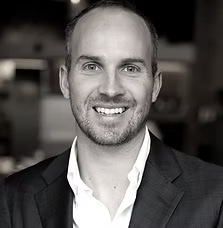
Written by Jeremy MacLeod, Co-Founder & GTM Hiring Specialist at The Search Experience. Jeremy guides Seed to Series C startups on how to hire GTM leaders and build revenue teams that drive sustainable growth.


Comments